|
|
|
|
|
An international consensus panel of ten glaucoma experts discusses best practices for MicroPulse Transscleral Laser Therapy 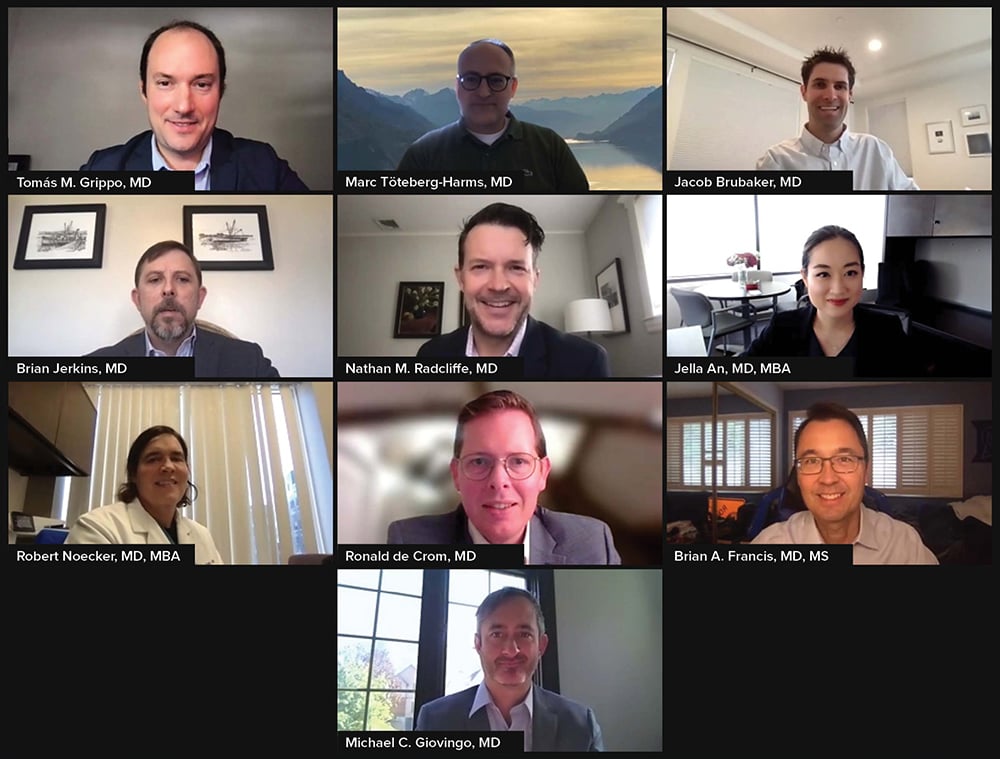
The panel executed a complete analysis of the clinical, technical, and practical experience to date and has developd a consensus document with recommendations for the clinical application of MicroPulse TLT. In Part 1, they share recommendations for dosing, optimization, and patient selection. In Part 2, they share recommendations for anesthesia, surgical technique, treatment enhancements, settings adjustment, complications, post-op care, outcomes, and durability. These discussions are excellent for learning how to maximize the safety and effectiveness of this non-incisional procedure performed with the MicroPulse P3 Delivery Device. What are the objectives of the
MicroPulse TLT consensus panel? Does the amount of energy have an effect on
IOP reduction and duration? What are the recommended settings for
the revised MicroPulse P3 Probe? What is the most important variable
that has been under-appreciated? Is MicroPulse TLT safe to be
performed in various types of glaucoma? Watch the full conversation
"MICROPULSE TLT CAN BE SAFELY PERFORMED IN PATIENTS WITH POAG AND ACG. VARIOUS TYPES OF SECONDARY GLAUCOMA CAN BE TREATED WITH MICROPULSE TLT." - Consensus Group 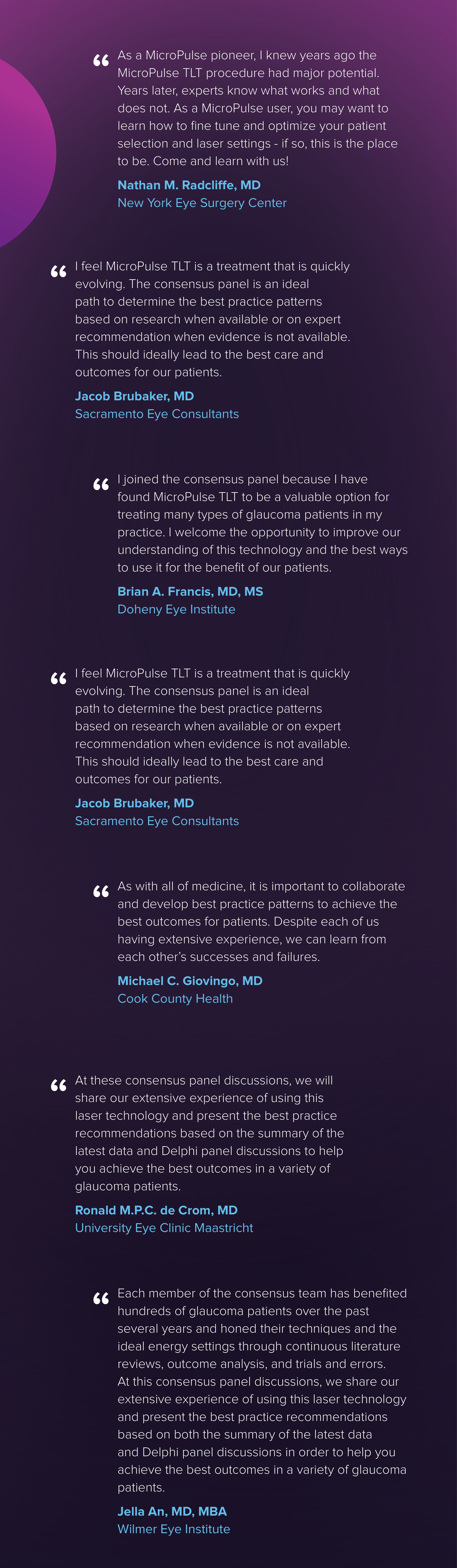 In Part 1, the following sixteen questions were answered: - Does the amount of energy applied have an effect on IOP reduction and duration of effect?
- Is there a “sweet spot” for the parameters used in MicroPulse TLT to achieve good efficacy while maintaining a good safety profile?
- Are fluence and total treatment time taken together the most representative parameters to reflect the amount of energy delivered to the eye during the MicroPulse TLT treatment?
- On the original MicroPulse P3 Probe, what are the most frequently published values of total energy, fluence, sweep duration and total treatment time and what are the expected outcomes with such values used?
- Have we already reached the upper boundary of energy delivery that allows us for a maximal therapeutic response with an acceptable safety profile?
- What are the differences in energy delivery and safety between the original MicroPulse P3 Probe and the revised MicroPulse P3 Probe?
- What are the recommended settings for the revised MicroPulse P3 Probe and how should this settings be adjusted?
- What is the most important variable for MicroPulse TLT that has been under-appreciated in the initial literature and in practice?
- What are the indications for MicroPulse TLT?
- Do we need to adjust energy delivery (parameters used) based on pigmentation or race?
- What are the expected outcomes for MicroPulse TLT based on disease severity and baseline IOP?
- Is MicroPulse TLT safe to be performed in various types of glaucomas?
- Is MicroPulse TLT safe to be performed in various stages of glaucoma and with different baseline IOP?
- Is MicroPulse TLT a therapeutic option in pediatric glaucomas and adult glaucomas?
- Can MicroPulse TLT be performed safely after incisional surgery or GDD implantation or before these surgeries?
- Are there any contraindications or cautions to MicroPulse TLT when it comes to patient characteristics?


Contact us at info@iridex.com for additional information. To learn more about MicroPulse TLT, visit iridexglaucoma.com. For more webinars, visit iridex.com/webinars
|
|
|
|
|
|
|